

It’s 4.36pm and I’m sat in the car park outside a small complex of flats that were built a few decades ago. The surface of the roads and pavements show its age in a way nothing else does: cracks and broken slabs dominate; dandelions and daisies opportunistically sprout through the gaps regardless. I look out of the car window, considering how unfortunate it is that the walkways are so damaged given every resident of these flats is an older person, living here because they need additional help to live independently. I feel disappointed that the very thing designed to help people live safely could contribute to their injury; I lament a little at how hard it is to build and maintain things that truly facilitate flourishing.
I’m not here to survey the road though. I’m here to visit Gerald. In fact it’s the last time I’m going to see Gerald and I’m already feeling a little sad about it.
At precisely 4.44pm, I make my way out of the car to his front door and check my watch. I wait until 4.45pm to press the bell; he likes me to be on time. The bell makes a dramatic sound but it’s one I haven’t heard before. Gerald’s house is full of sounds, but they all seem to change constantly. His door bell plays a different sound on rotation (hence my unfamiliarity this time), his clock plays a different bird song on the hour every hour, and his mobile phone sounds like a warning siren, because it’s set to max volume on account of the fact that he never knows where it is because it’s under piles and piles of what Gerald calls his ‘stuff’.
I can hear Gerald shuffling to the door and he’s already talking to me, even though I can barely hear him over the sound of the door bell, which still seems to be ringing. Gerald pulls the door open and beams at me, instructing me to come in and sit down, moving piles of paper from the sofa cushions, which are adorned in newspapers and advertising brochures — the kind that sell novelty door bells and clocks that make bird noises.
I spend over an hour with Gerald, talking about his health, his life, his family and his past. He’s just started telling me another story — I’ve already heard it, but even if I hadn’t, it’s time for me to go. He knows it too… that’s why he started telling it. I interrupt as kindly as I can and ready myself to say “goodbye” — I’m emotional at the best of times, but I know this goodbye is going to be especially hard.
Gerald looks down at his hands. They’re balled into fists as if they’re trying not to lose something precious. In barely a whisper, Gerald says, “Is that it then? Do you have to stop coming now?”. “Yes”, I say. “This was the last session”.
I remind him that I’ll be in touch again to let him see the write up of the research study he’s taken part in and I thank him again for being so generous with his time as a study participant. Gerald looks up, loosening his grip a little and I see that he’s been holding onto a handkerchief. Tears start streaming down his face and I realise that he’d prepared himself for this goodbye too — readied his handkerchief to wipe tears that he knew were going to come. “You don’t need to thank me,” he mumbles. “I need to thank you. I never thought I’d ever get to tell my stories to anyone again. I didn’t think anyone would want to listen to me.” He pats me on the shoulder and I know it’s his equivalent of a hug. “Thank you for making an old man very happy.”
I smile, swallow what feels like an enormous lump in my throat and fight back tears — I’m trying to stay professional. But I’m such softy, it’s taking every ounce of effort; I do one of those strange inhales where you feel you like you’re being breathed rather than breathing. “You’re most welcome,” I say, and it comes out as more of a squeak. I tell Gerald to take care of himself and then I take a long, deep exhale as I let myself out like I have done every other time I’ve visited. The birds have just started tweeting from the clock and it’s definitely time for me to go home.
And as I close the door I realise that as bittersweet as it is, I feel so privileged to have been able to hear Gerald’s stories, to hear anyone’s stories — to be given the opportunity to find the wisdom in a situation, an experience, a life. That as a researcher I get to translate those stories into something which can be used to design change: change that creates better processes, more effective systems and services, improved experiences. I recall the times I’ve wondered if I’m doing enough; worried about whether qualitative research can ever make the difference that it needs to in such complex and challenged systems as the ones we live and work in.
But as I walk back to the car, over cracked and broken pavement slabs, which I know no story will ever be able to mend directly, I realise that the power is not just in what participants do in their contributions to our studies, it’s never only in the findings that I produce from them, or the recommendations for change that come from them. The power is also in the potency of the process. In the carefully crafted questions and the intentional inquiry; in the deep and analytical listening to capture every spoken and unspoken thing; and in the witnessing of someone’s experience, without judgement or verdict. So research may not be able to mend paving slabs, but:
- the stories people tell because they are invited to,
- the experiences someone shares because someone asked,
- the tender spot that was cared for because someone listened, and
- the change that can happen because someone gathered them carefully
They are like the daisies that I step over carefully as I make my way back to my car. They exist despite the challenged and broken systems, they’re evidence of hope breaking through the cracks. Like the flowers, stories are the evidence of life flourishing anyway.
I’d heard this story 7 times now. The first telling was the best. Full of details - timings, sensations, feelings. Each retelling became more and more sparse. The teller assumed each new person knew what the previous had been told. As I sat and listened - unable to share the minutiae I knew existed but were not mine to tell, I wondered if anyone realised that the most knowledgeable and expensive person in the team was hearing the least amount of information. Their specialism was impressive and their ability to ask questions was remarkable. But it was like watching someone have to solve a crossword puzzle with half the clues rubbed out.
“What are you doing now?”, I ask. That was question 1. I have so many more. ‘Why are you doing it? What is it for? What happens after? What needs to have happened before this?’ This is the stage of my work where I feel a bit like a curious pre-schooler. 
“I’m taking these forms to complete”, she tells me, shuffling a large stack of paper into a neater pile.
“How long will it take you?”
She takes a moment, as if calculating in her head. “Probably about 2-3 hours for these”
We talk more as I accompany her along corridors, moving further away from where the action is. Me asking questions, her answering them. We bump into 3 members of staff en route. Everyone wants something from her; all require a small amount of time. The paperwork wins. But she doesn’t want it to and she shares her frustrations about having to prioritise paperwork over people.
“This is why I have to use my colleague’s office. She’s not in today, so I use her office to hide from staff so I can get these done. Otherwise people come and ask me things every 5 minutes”, she laughs but it’s not in a way that indicates she actually finds it funny.
This kind of work is a bit like doing a jigsaw. Until I’ve put the puzzle pieces together, it’s not always possible to know which details I’m gathering are describing normal every day work, and which are the ones that will stand out as pivot points for organisational learning. But when I ask my next question, her answer tells me immediately that I’ve found a ‘corner piece’. I also know that the jigsaw I’m putting together won’t match the picture on the front of the box.
“Who uses these forms?”, I inquire. She drops the thick stack of paper down in front of her, and the deadened thud they make as they land on the desk seems like the perfect auditory expression of the task at hand.
She gives a wry laugh, an amused acceptance of a ludicrous situation. “Oh, no one uses them!”, she replies. I wait. I sense her irritation and I pause my response - it’s an invitation to tell me more, to share her frustration.
“A couple of months ago, management realised that these forms weren’t being completed all the time. So now they set them as a target and we are measured against them as team leaders”.
“But no one really uses them?”, I check again.
“No, because we already have this information in another form that we complete earlier in the process, and that one’s actually useful.”
I thank her for her time and wish her luck with getting through the large stack in the time she has available.
I return to the hustle and bustle of activity and I hear her name mentioned on repeat… ‘where is she?’, ‘I need her for this!’, ‘she’s the only one who can do that’, ‘do you think she’d have time to talk to me about that thing I need help with?’ But she’s not here to help with any of those things.
Every week senior members of the team spend hours each week hiding from their staff members in the hope of having enough to time to complete paperwork that no-one looks at, except to say whether it’s been done or not.
It’s not just in this team either. It’s in every team. And I wonder if leadership realise the impact of their intervention: whether anyone knows the cost of improved form-completion metrics? Sees the impact of mandating hours of paperwork completion by highly skilled and experienced members of staff? Or knows that for several senior team leaders, for several hours each week, their job is getting in the way of their work.
I solve problems people don't know they have.
You may already know where difficulties are showing up: a recurring conflict, a stuck decision, a relationship under strain, a project that is not moving, or something that keeps happening despite your efforts to change it.
What might be less obvious is what is organising it: the factors that are shaping the problem.
That’s because sometimes the presenting problem isn’t the problem you need to solve — it’s the data that can help you understand the underlying pattern.
That’s what I work with.
It might be a symptom of something deeper, part of a wider pattern, a response that no longer fits the situation, or even something useful appearing in an unhelpful form.
That is why I do not start with solutions. Solving the wrong problem can be worse than not solving it at all.
I start by working out what is shaping the situation, what kind of problem it is, and where attention is most likely to make a difference, so that what happens next fits the purpose, problem and context.
“I found the entire experience incredibly powerful. Her framework is exceptionally well considered & intentional. There is a real depth to the thinking behind it, and the way she has designed the process makes it feel both purposeful and transformative. I’m excited to begin my experiment and see what transforms as I put this into action. Just thought I’d share for anyone who is considering joining her - I’d highly recommend.”
— Helen Lea, 1:1 Discovery Session (single session)
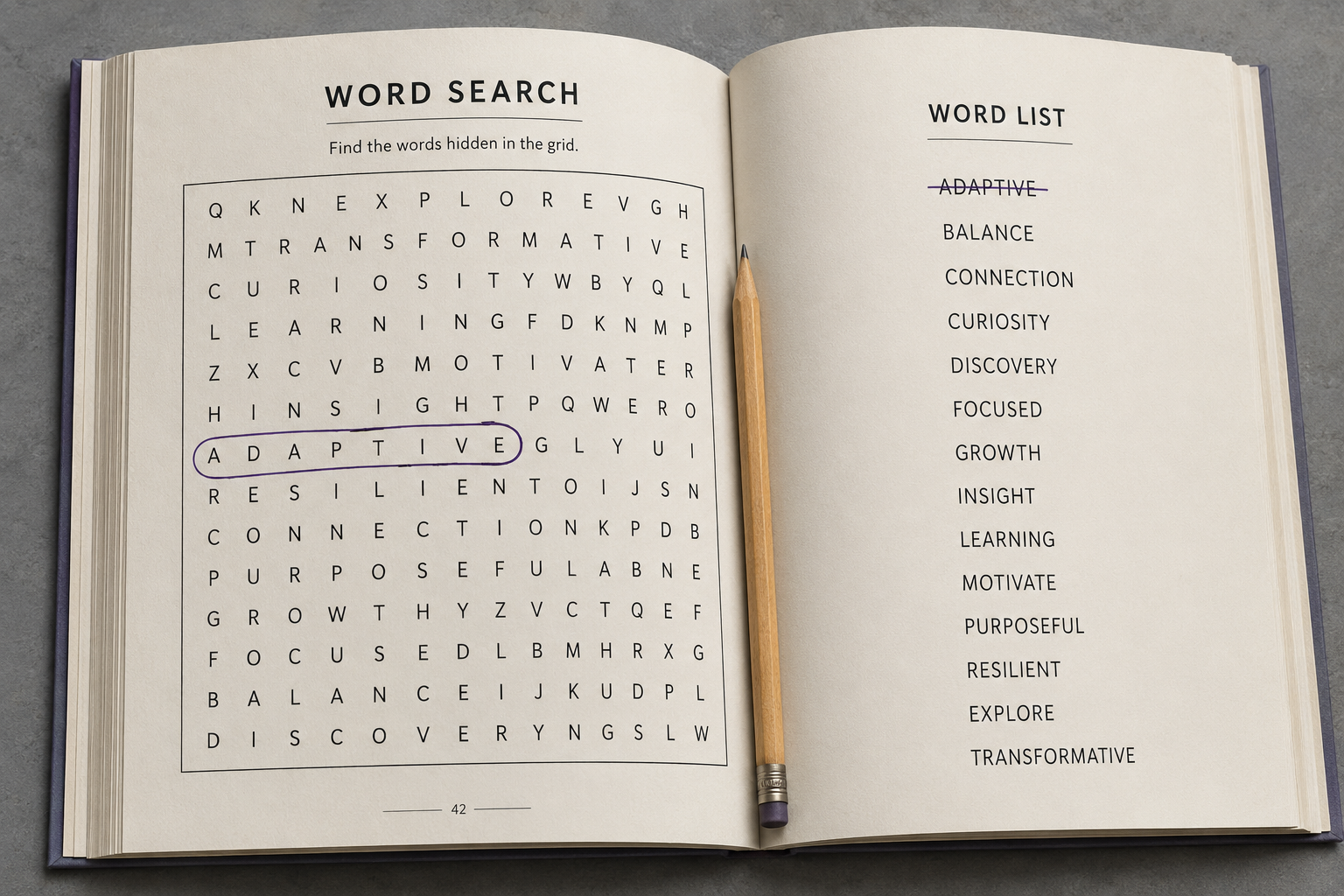
Not every problem is the same kind of puzzle.
Some problems are a bit like wordsearches: once you know what you're looking for, finding it is relatively straightforward.
Others are more like cryptic crosswords. The obvious reading isn't necessarily the useful one.
And some are pattern puzzles. You need to understand the relationships between what's already there — and what isn’t — before you can work out what might fit.
Sometimes, what looks like one kind of puzzle turns out to be another.
The trick is working out what kind of puzzle you're dealing with before deciding how to solve it.
In my practice, that means paying attention to three things.
And I start by reading situations.
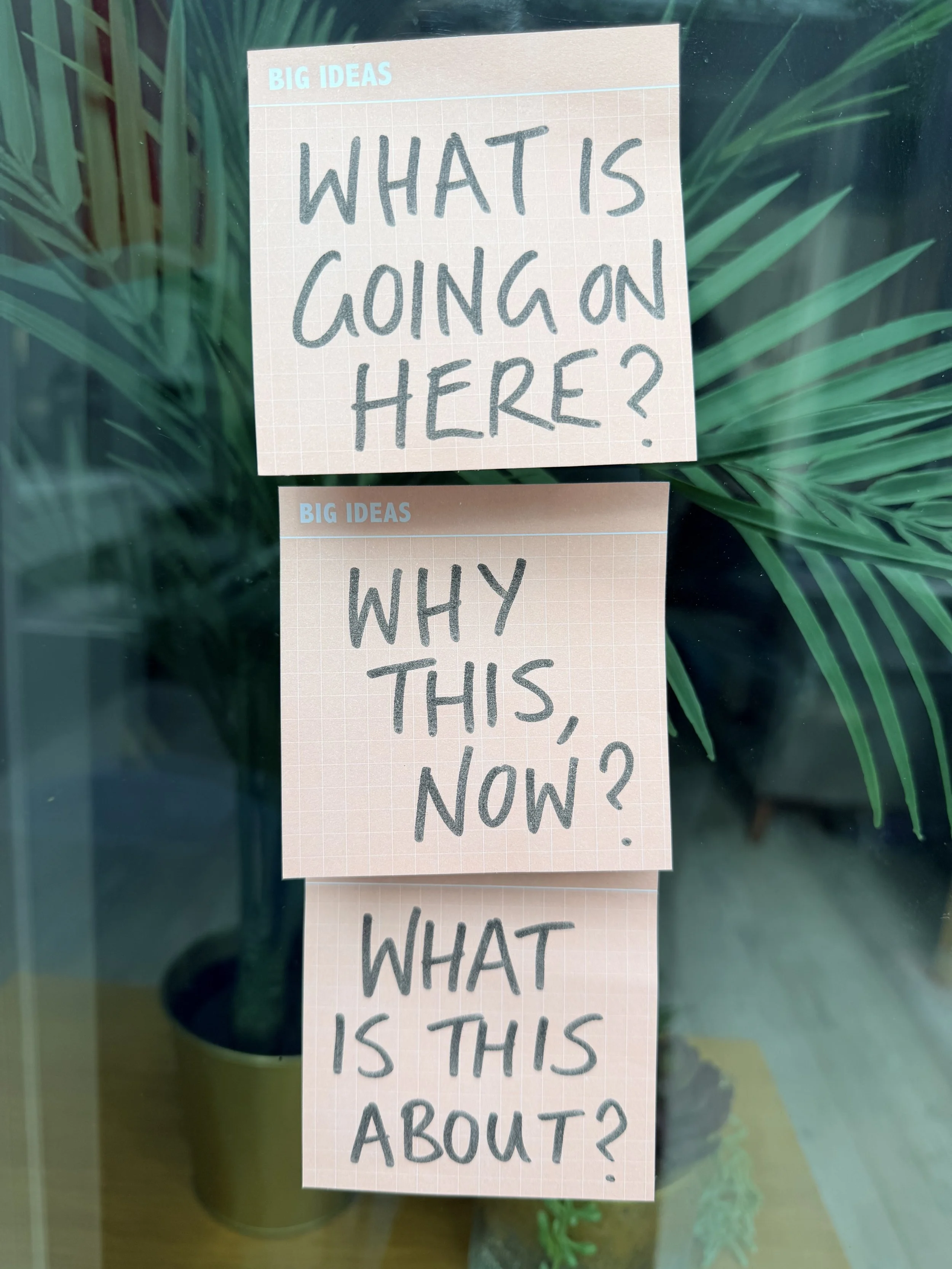
I want to understand what is happening. I also want to explore what is organising what is happening — I do that by exploring what the situation is about. Because things that look similar can have very different purposes.
A behaviour can look the same whilst serving a different function. A recurring problem can have different things organising it. Two teams can appear to be struggling with the same issue but need very different responses.
And when we’re in the middle of a situation, its visible shape is often the easiest thing to see. What it means, what is producing it, and what matters about the context can be much harder to distinguish.
So I pay attention to both similarity and difference: what looks familiar, what doesn’t quite fit, what changes with context, and what might be having more impact than it first appears.
Because recognising the shape of a problem can tell us where to start.
Understanding what that shape is doing helps us work out what might actually help.
Sometimes that’s an episode of focused inquiry that understands and unlocks a single stuck moment. Sometimes it's working alongside someone or a team for longer, so the pattern — not just the instance — has time to be seen, understood, and worked with. Other times it's delivering a talk or a session that helps an audience reframe something familiar, see additional dimensions of a situation, and encounter practical possibilities arising from a different perspective.
All approaches share a common goal: to help people and organisations develop a greater sense of what is happening, understand what is shaping it, and identify responses that fit — so they can respond with greater clarity, discernment, and alignment.
Doing this once is adapting;
Doing it repeatedly is adaptive;
Doing this to guide your life, team or organisation is Adaptive Navigation.
I designed the Adaptive Navigation System to make this repeatable — not just a method for solving one problem, but a way of reading situations so the right response becomes easier to find.
I work with people, context, and people in context.
Here’s where that starts.
Which of these best describes how you prefer to access information?
-
The About page is the story of NH Adaptive and a little bit about the Adaptive Navigation System.
-
The Services page is for you. It contains high level details of the different things NH Adaptive offers.
There are links to the detailed pages if you do want to read more.
If you’d prefer to talk things through then you can also a book a call.
-
Looking at the options in the dropdown on the right can help guide you to the page that fit’s best in relation to what you’re looking for.
You can also use the Services pages if you’d like an overview and links to each of the pages individually.
-
Downloadable versions are below:
Which of these best describes what has brought you here?
-
You may be facing a consequential decision, transition, relationship or just feeling ‘not-quite-right’ or that things could be better but you’re not sure why or where to start.
Explore Individual Adaptive Partnership -
You may be noticing recurring tensions, misalignments, or unintended outcomes and impacts and would like support to understand what’s going on and how to find a response that fits.
Or perhaps you’re seeking to understand, preserve and build on what is already working particularly well and would like support to capture and codify why, so you can continue making progress.
Explore Team Adaptive Partnerships & Organisational Adaptive Partnerships
-
You may be looking for a keynote or applied session that reframes something familiar, expands how people understand it and creates useful possibilities for what comes next.
Explore Adaptive Perspectives
-
You may not know exactly what needs to be ‘fixed’, you may be wondering whether an Adaptive Partnership is the right next step. Discovery is part of the Adaptive Perspective family, which provides a bounded inquiry with value in its own right.
Explore Adaptive Perspectives: Discovery
-
You may want to know how the thinking behind this approach works, not just what it produces — or you’re curious about the person who built it before you decide whether any of this is for you.
About the Adaptive Navigation System or the full range of Services